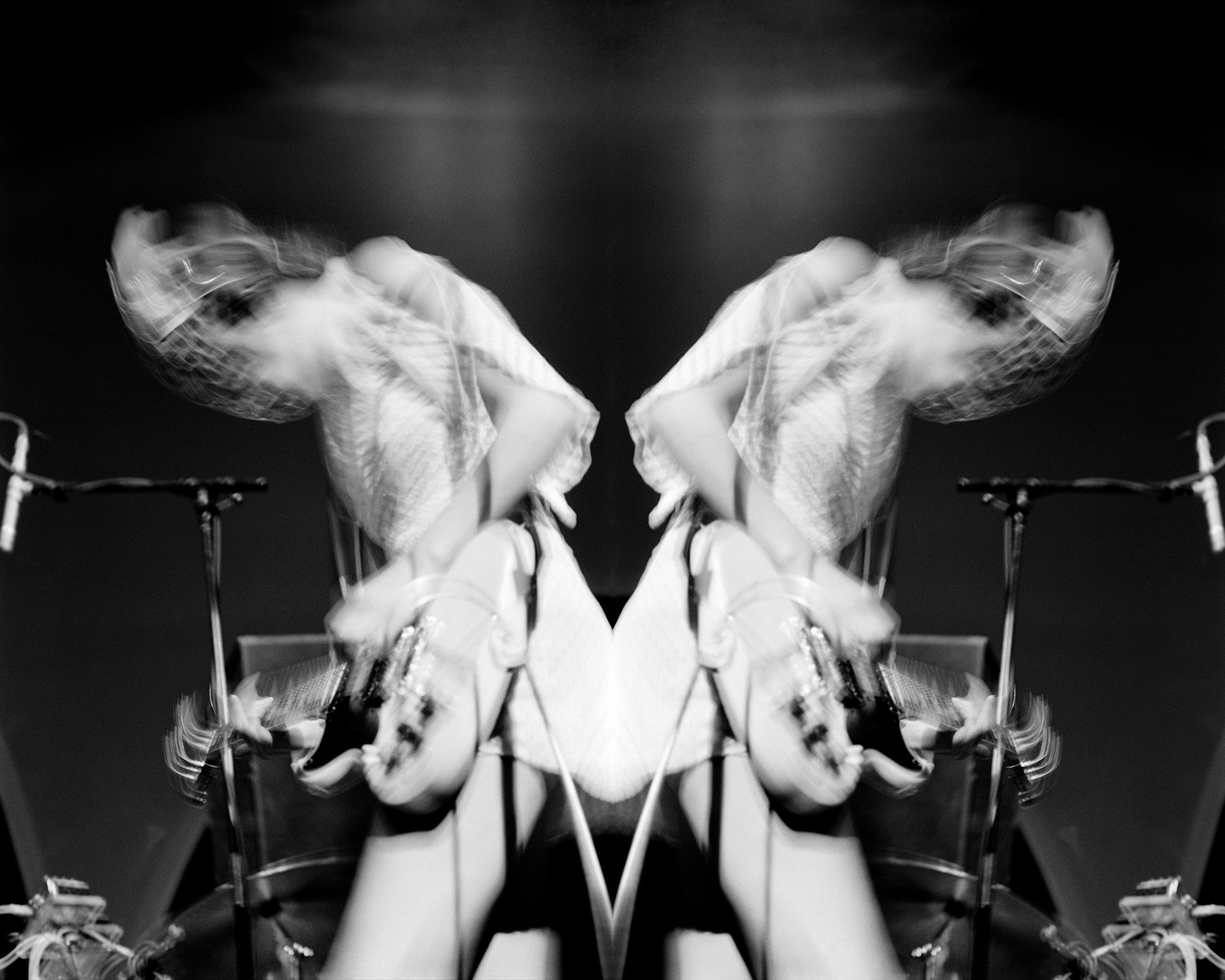
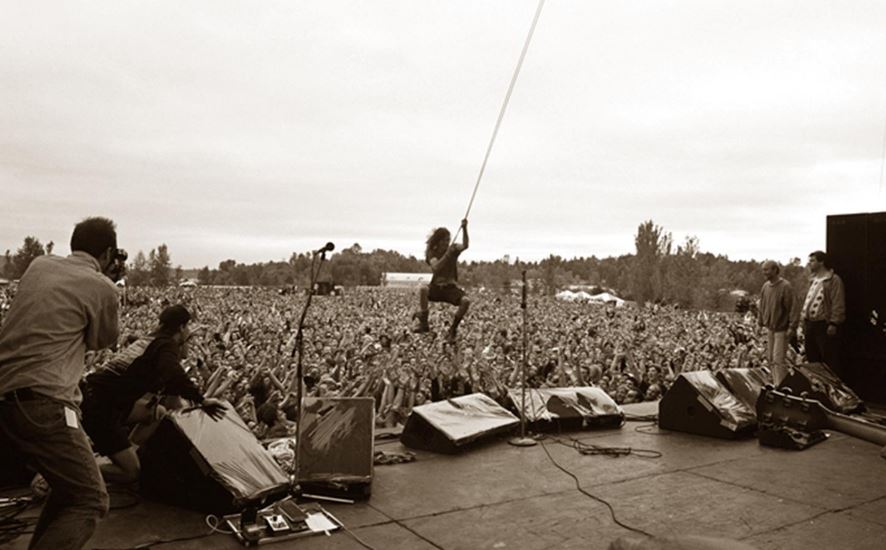
If you’ve been following Guerrilla Candy for a while then you already know Smokey Brights are one of my favorite local bands. Lead by the husband-wife duo of scene veteran Ryan Devlin and Kim West, they’ve been a staple of the local music scene for more than a decade. No two Smokey Brights albums sound alike and the group’s latest record, “Dashboard Heat,” is their most immersive and diverse record to date.
The record touches on themes of home, cars and galactic space (as evident by the cover art) and its three diverse singles are a great representation of what to expect from the album. You’ll get narrative-driven songs about home (“Home”), tales about the challenges of living through the now (“All In Who You Know”) and some of the band’s self-described road trip rock (“Peace Sign Pentagram”). It’s a fun and playful record filled with lyrically compelling storytelling and catchy tunes that merits repeated listens.
I was thrilled to chat with Ryan and Kim earlier this month to learn more about the band and “Dashboard Heat.” Below is an edited transcript of our conversation.
The Smokeys started out as a four-piece that was a folkish band. How did that evolution come from a four-piece folk band to a four-piece pop-rock band?
RYAN: Yeah, I think we just started leaning more into the writing. You play as an ensemble long enough and you start to figure out your strengths, I guess. One of the strengths we found out was we can harmonize really well together, so we can make these big hooky choruses.
I think the idea was just to kind of be more of like a songwriter project, and that looked a little folkier in the beginning. We still do shows where I’ll just play acoustic guitar and Kim will play piano and voila. It’s folk just from the trappings of the instrumentation.
I think the writing just started to get a little more pop because that’s where our ears were going. If you listen through all the Smokeys records, each one of them has a kind of a different flavor. And I think from the outset, we’ve tried to be a band that allows ourselves to do that. We always say we want to be like a 50-year band. We want to have like whole eras of what we do and allow ourselves to grow and change with it. So you never know what a new record is going to be like.
KIM: We were listening to a lot more like LCD Soundsystem and stuff like that and wanted a lot of bigger, fatter drum sounds and more samples. “Dashboard Heat” is kind of like a dance record. And then, you know, the next one might just be acoustic guitar and voice. Who knows?
How did Kim come into the band, because she wasn’t an original a member.

RYAN: Well, Kim’s on the very first demos singing. And by the first summer when we were playing shows, Kim was sitting in singing harmonies. Then maybe a year into it I was like, well, you played keyboards, it would be great to have another voice in the band.
And then on our second record you started more writing and taking leads?
KIM: Yeah. It just kind of started happening
RYAN: And then by virtue of being two married people that play music together all the time, the songwriting started to get just more and more co-mingled. If you live in a small space and you’re both working on songs, you are inherently working on each other’s songs.
It’s always a West-Devlin or Devlin-West kind of set up, like a McCartney-Lenon, right?
RYAN: It kind of is. Yeah. Yeah. I mean, even our most recent single, “Home,” is like mega, mega autobiographical about my childhood. Still with that, Kim had a big hand in melody and lyrics and composition and stuff like that.
So what’s it like working as a married couple? Demystify the cliches of being a married couple in a band together for me.
RYAN: I think people automatically think of the cases where it gets dramatic or sticky and like, I would really challenge that, like, I would say every one in every three touring bands I come across has a couple in it.
KIM: I think with how much travel and time away from home is involved in playing music, it’s a pretty natural arrangement to go out and do it together as a little family unit.
It’s never been like a cocaine fueled drama mess for us. The work is hard enough without making it hard on yourself. For us having our person out with us makes touring so much nicer and more stable and calm and happy.
RYAN: It’s an emotionally tough thing to do, to just travel and play shows. And I find it way less tough having the love of my life out there with me.
How did you guys link up with (producer) Andy Park? He’s worked on a lot of big records.
KIM: We have a lot of mutual friends with Andy, and we were looking for who was going to be our producer for the next album.
He’d worked on a lot of stuff that we loved. He worked with Deep Sea Diver, Ruler, Cataldo, Death Cab and all these great local and national bands. We really liked his style, but also knew he didn’t take everything sent to him. So we sort of sent him our demos and went out for coffee. And he was like, I like you guys.
RYAN: He’s very critical and that’s why he is good at what he does.
KIM: His MO for everything he does is that he wants to make it undeniably good. Whether or not you like the genre, whether or not it’s your flavor. He wants to make music that you listen to and you can’t help but say ‘this is good.’ Even if I’m not into alt country or I’m not into indie pop or whatever, it’s like, you can’t deny that it’s really good. That’s the level of excellence we were trying to get to.
RYAN: And he’s an effective person to have in the room. He feels like an authority. It’s like, I better get this lyric right. Because if not, he’ll be like, what’s up with that? He’ll question you to make it better.
KIM: He makes you want to work better. Write better. And be better at what you do. It’s very much like he hands you the keys. You’ll play something and he is like, ‘Okay, I like that, but less notes. Try it again.’
And so then you’re like, oh shit. Well, less notes. What are the notes that actually are doing the thing I’m trying to do, and what are the notes that I can leave behind? It’s really lovely to work with him.
A few years back, you guys received a grant from Sonic Guild, an excellent organization that supports musicians. How did that help your career?
RYAN: We got that grant in the year 2020 and at the time we were just about to release our album “I Love You But Damn.” We had printed records. We had printed t-shirts. We had obviously paid for the studio time and all that kind of stuff.

We were going to be on tour all of 2020 where we would make back that money we invested. But of course, that tour, along with so many other more consequential things, were canceled. That grant helped us get out of debt. I think that is likely what that chunk of money represents for a lot of artists.
KIM: And that’s what’s so amazing about the Sonic Guild grants. So often there’ll be money made available, but there’ll be strings attached. Like, oh, you have this to make this. But with Sonic Guild, they’re like, we understand you probably just need cash. And it’s unrestricted.
So we used it to pay for the record we just made. We’ve had friends who’ve used it to buy a touring van or, you know, we had one friend who’s like, I’m literally just paying off my credit card debt, because I can’t even imagine going on tour with the credit card debt I have right now.
Each artist gets to use the money how they need it which is super useful.
RYAN: I’m extremely grateful. I wish there was a chapter in every city and I wish the budget was a hundred fold so we could just support everyone’s art.
So on that note of receiving help, you’re also giving back and working with your label Share It Music. Talk about the Vera Project, what it is, what it means to you, and why you chose to partner with Shere It and donate some of the proceeds of your album to such an awesome organization.
KIM: Yeah. Well, we had. We first started working with Shere It on the (Smokey Brights side project) Mega Cat record last year and that was our first time working with Cayle (Sharratt, Share It Music founder). Uh, we’d have friends who’ve worked with him, like he’s released Cumulus and Spirit Award and you know, so we knew him around town as you know, this really awesome person.
So when we started working with him with Mega Cat, it was like, oh, this is fantastic, like best label relationship I’ve ever had. Cayle is so intentional and also just really a massive lover and supporter of music. Part of the label’s business model is 10% of proceeds go to an a nonprofit of the artist choosing, and it was just a natural fit for us to
go with Vera. We both grew up going to Vera shows. And it’s a big reason why I think both of us are doing what we’re doing.
RYAN: If you don’t know Vera, it’s an all-ages venue, screen printing, studio recording space. It’s a creative space for education, a safe space for youth. And we don’t have a lot of spaces like that in this ever increasingly expensive, difficult to navigate city. So spaces like Vera are super duper important and the fact that it is right in the middle of Seattle at Seattle Center and accessible to a lot of kids is just really amazing.
We’re honored to do what we can to keep supporting them. Playing live music, especially in the Seattle music community, has given us such a sense of self and self-worth. So to be able to give back a little bit to a space that is passing that on to a younger generation feels like the right thing to do.
Talk about some of the themes on the album. Things that I pick up are, are empathy, love and family. What are some themes spread across the album?
RYAN: It’s a big album emotionally. There’s definitely themes of home and family is a big through line for this record. A funny theme that we didn’t even realize until we got through recording them all was cars. There are cars are all over.
KIM: Cars and vans and scenes taking place in cars
RYAN: It just, I guess we live a lot of our lives in cars and we tour quite a bit. There was like a half second where we were maybe going call the album American Car Crash and then we were like that’s too dark, we can’t do that.
There’s also a lot of cosmic imagery. Imagery of stars and space. And space as metaphor for emotional space.
It feels like a record that has strong touch points in literally home. There’s a lot of songs about childhood and where we come from.
But then from there, we kind of go out into the cosmos. You know, we named it Dashboard Heat because one of the genres we’ve been attaching to lately is road trip rock.
We have so many friends and fans that are like, ‘I love Smokeys. I specifically listen to Smokey when I go on a long road trip.’
I think our music and our albums can be a little more like long form media. It’s more of like a podcast than a TikTok. And this album fits into that. We would love nothing more than for people to listen to it in its entirety on a road trip and kind of go on this whole journey.
A couple of songs I wanted to ask about are “Northgate Way” and “Roman Holiday.” Two very different sides to the spectrum.

RYAN: If one of the themes of the record is home, “Northgate Way” is a snapshot of where we’re at right now.
We are taking this call from, several feet away from Northgate Way. It’s the street that we live on.
It’s such a funny little place. It used to be home to the mall, but the mall is like a big pit and it’s being kind of currently built and re-envisioned. And for some reason living in that kind of half torn down, half built, kind of always in flux space, seemed to fit into a lot of the themes on this record.
KIM: It’s the first and definitely the best song ever written about Northgate Way.
And “Roman Holiday” is one of my favorites on the record. It’s a song about growing up as a woman in America. And a lot of those little stories from it are autobiographical.
Some of them are sort of exaggerations of experiences I’ve had. But you know, my cousin really did rip my earring out of my ear wrestling on the lawn.
We had the chorus and the term Roman holiday first. And, Roman holiday is sort of like having a jubilant time at someone else’s expense.You know, you’re having a great time because someone else is suffering, which is a little bit what it feels like right now in this country. There’s these powers that be that seem to be having a great time just making it shitty for everyone else. And that’s been a theme for a lot of communities in America for a long time.
Women and women-identifying individuals are just one of those communities, but it’s the one I happen to identify with. So that was how that one came together. It’s a real rocker.
One of the things I love about this record, and it comes across in a lot of your albums but on this one it really does come through, are the details and the storytelling. There’s very vivid imagery. Is that difficult to do as a songwriter, to convey those sort of details?
KIM: A lesson we’ve both been learning in the last few years is getting specific with your lyrics, making them personal and detail oriented, actually brings more people in. It seems like it would do the opposite, like I’m just writing about my specific little experience here, but it turns out we’re all humans and we all have a lot of the same feelings and a lot of the same experiences.
So if you felt this weird, shitty feeling, or this beautiful jubilant feeling, chances are somebody else has felt it too. And if you’re describing the context for that feeling, chances are some people have had those experiences, you know? That’s something we’ve sort of been allowing ourselves to lean into more than on the earlier records.
You guys did something really fun with your album artwork and your liner notes. How did that idea come about?
KIM: We got connected with, (artist) Bruno Caesar because he literally just messaged us on Instagram and was like, ‘Hi. I love your music. I’m an artist from Brazil. If you ever need album artwork, hit me up. Here’s my website and here’s my portfolio.’
RYAN: But Bruno Caesar’s stuff is just gorgeous and surreal and vintage feeling and textural. And we had just finished this record where a lot of the themes were about home, the journey away from a home space. It was really like his stuff was already in line with what we were doing. So we were like, do some of your crazy surreal art to this. Here’s the record.
And then he, he just like dove so deeply into Dashboard Heat. He came back and he’s like, okay, I have a vision. It’s Ryan and Kim on a journey on the moon. Fueling up your van.
KIM: He found a way to put one image from every song into this cover image And it’s beautiful.
RYAN: It’s so beautiful, and everyone kept being like, it looks like the front page of a comic book. So after he finished we reached out and asked if he would like to make a lyric comic book. Then the whole process started all over again.
I absolutely love the idea of someone getting this record, putting it on their turntable and getting to flip through this story and maybe get a deeper sense of who we are.
Discover more from Guerrilla Candy
Subscribe to get the latest posts sent to your email.