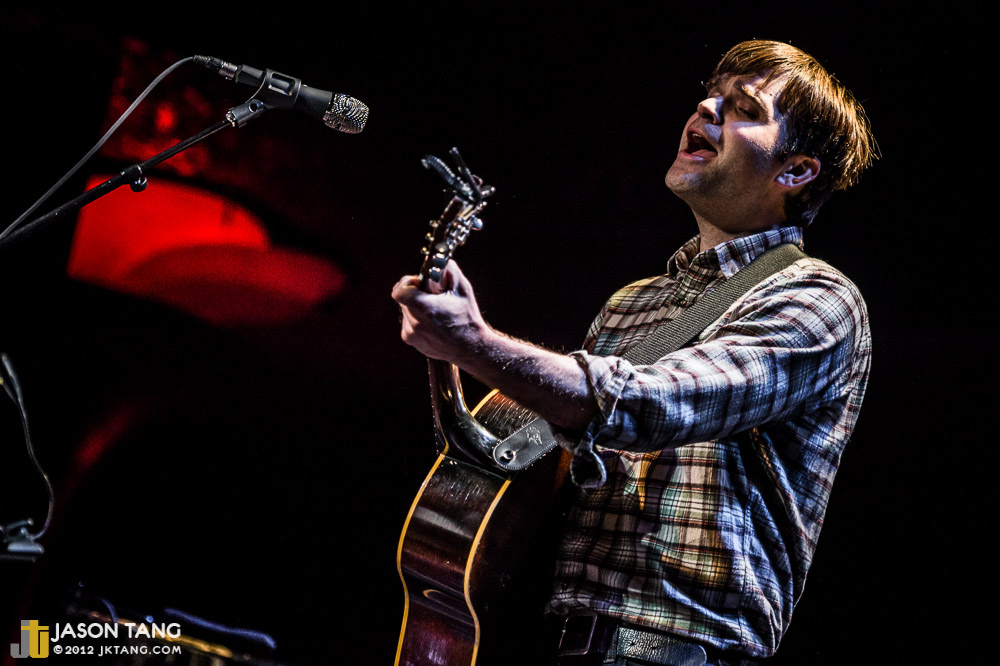
Like so many artists, Death Cab for Cutie’s plans were upended in 2020.
Originally slated to record with legendary producer Flood in the UK, the pandemic made travel impossible. “We figured, let’s try to do something unique and once-in-a-lifetime,” Ben Gibbard, Death Cab’s frontman, recalled. “But the expense, the logistics, and the reality of the pandemic made it virtually impossible.”
Instead, the band leaned into experimentation. Gibbard devised a songwriting exercise he called the “round-robin.” Each member would take turns adding to a track throughout the week, with full editorial control at each stage. “It was the first time in Death Cab’s history we worked that collaboratively,” he said. The result was a record that blended Gibbard’s compositions with true band co-writes, a refreshing shift in their creative process.
While “Asphalt Meadows” was born of pandemic circumstances, Gibbard resisted making it a “pandemic record.” “I feel like all of our records are kind of sad and desolate,” he admitted with a laugh. “But the themes that interest me, distance, faith, existential questions, have always been there.” Still, songs like “I Miss Strangers” inevitably reflect the era. “Someone said to me, ‘I miss strangers more than I miss my friends these days.’ That really stuck.”
For Gibbard, the pandemic didn’t redefine his songwriting so much as reinforce long-standing themes. “Music has always been about emotional and physical distance for me,” he explained. “The pandemic just gave those ideas new resonance.”

One of the most striking aspects of “Asphalt Meadows” is its sonic heft. Fuzz, distortion, and even a minor punk energy permeate the record. “As I get older, I don’t want to make old-person sounding records,” Gibbard said bluntly. “I don’t want slower tempos, acoustic guitars, or swelling strings.”
That ethos drove the band to embrace louder, more visceral sounds. “We like playing rock songs on stage,” Gibbard said. “So why not make rock songs for the records?”
Perhaps the most surprising track on the album is “Foxglove Through the Clearcut,” a spoken-word piece layered over interlocking guitar, bass, and drums. Its origin story is quintessentially Death Cab. Early in the pandemic, Gibbard digitized his old four-track tapes from the late ’90s. One instrumental from 1997 became the backbone of “Foxglove.”
“When people say it sounds like old Death Cab, well, it actually is old Death Cab,” Gibbard laughed. The decision to deliver the lyrics as spoken word came naturally. “It felt like it needed a Slint-style spoken word piece over top.”
Being in a rock band is raging against the dying of the light
Another standout, “Rand McNally,” serves as a tribute to the band’s early years. “It’s a song to our younger selves,” Gibbard explained. “Cataloging flashes of memory from the lean years—mustard sandwiches, crashing on floors, surviving in the van.” The refrain, “I won’t let the light fade,” underscores the band’s commitment to honoring their past while pushing forward. “We put all this work into this band. I won’t half-ass it. I won’t give it up willingly.”
Gibbard’s lyrics often evoke lived-in worlds, and one line in particular, about watching movies from the 1950s and realizing everyone onscreen is now dead, captures his fascination with art’s immortality. “I’m fascinated with immortality through art,” he said. “Not necessarily for myself, but because music especially becomes a character in our lives.
Unlike film, music is portable, omnipresent, Gibbard pointed out. “You can listen to Billie Holiday every day, and it’s as if she’s still with us,” he said. “Music more than any other art form carries that striking brand of immortality.”
Interestingly, “Asphalt Meadows” also spawned an acoustic companion album. The idea began as a marketing ploy from Atlantic Records, hoping to land tracks on streaming services playlists. But once in the studio, the band decided to record the entire album acoustically. “We realized, let’s just do the whole record,” Gibbard said. “We’d been touring the songs for months, so we knocked it out in five days.”
What began as a label strategy became a standalone work. “I’m really proud of it,” Gibbard said. “If you like the record, it’s a nice addendum.”
With ten records (plus the acoustic companion) and nearly 30 years behind them, Death Cab’s legacy looms large. For Gibbard, the goal is simple: consistency. “Not every record can be the best record,” he admitted. “People have their favorites, their eras. I get that—I’m a music fan too.”
But what matters most is that the band’s commitment is evident. “I’d like people to think we were consistent in quality, in live performance, and that we never took it for granted,” Gibbard said. “The fact that this has been my livelihood for 26 years blows my mind. When you’re handed such an opportunity, you have a responsibility to put your back into it.”
“Asphalt Meadows” isn’t just another Death Cab record—it’s a statement of intent. Born of pandemic limitations, shaped by collaboration, and infused with renewed energy, it marks a return to the band’s core identity while pushing into new territory. For Gibbard, it’s about rejecting complacency, embracing rock vitality, and honoring the band’s journey.
As he gets closer to turning 50, Gibbard sees music as both immortality and resistance. “Being in a rock band is raging against the dying of the light,” he said. And with “Asphalt Meadows”, Death Cab for Cutie proves that their light is far from fading.
Discover more from Guerrilla Candy
Subscribe to get the latest posts sent to your email.