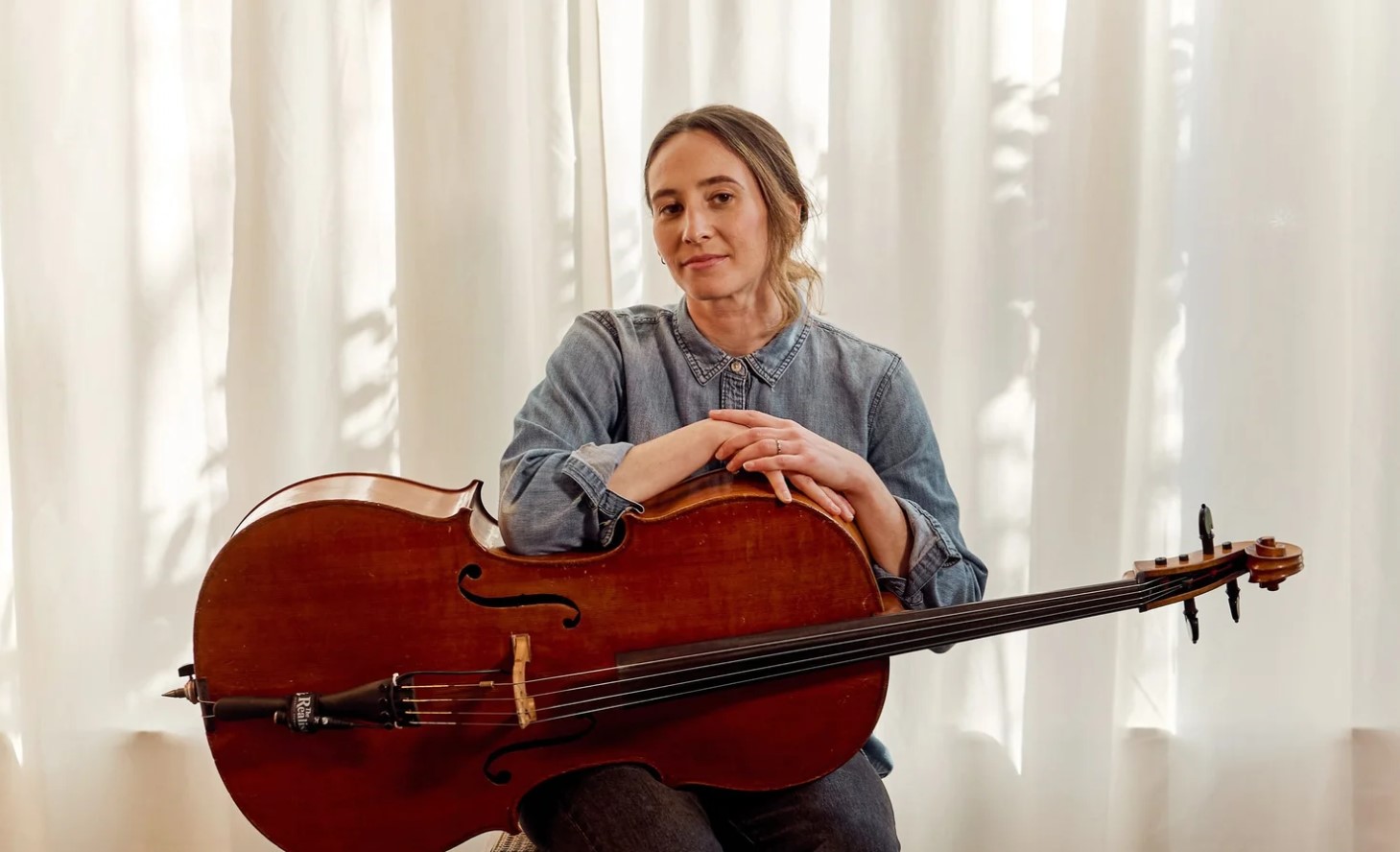
Ollella is one of those rare Seattle artists who can stop a room cold with nothing more than a voice and a moment. The project of classically trained cellist and vocalist Ellie Barber, Ollella blends indie folk, chamber pop, and a kind of windswept Pacific Northwest mysticism into songs that feel both intimate and cinematic. It’s music built on tension and release—quiet confessions that bloom into soaring, full‑bodied arrangements—and it carries the unmistakable fingerprints of someone who understands how to make emotion feel physical.
What sets Ollella apart isn’t just the cello, though Barber uses it like a painter uses color, shifting from percussive rhythms to lush melodic lines with ease. It’s the way the songs move. There’s a sense of motion in everything Ollella creates, like the tide pulling in and out or headlights tracing a late‑night drive. The music feels alive, breathing, restless in the best way.In a city known for reinvention, Ollella stands out by leaning into authenticity. The songs carve out a space that feels wholly its own—one where classical training meets indie experimentation, where emotion meets craft, and where listeners are reminded that sometimes the softest moments hit the hardest.
I recently spent some time with Barber and we chatted about Ollella’s successes, her recent NPR Tiny Desk concert and what exactly makes an instrument “human.”
My first question is what drew you to the cello?
Ellie: Yeah, it brings me back. I started the cello when I was nine years old and then I played piano before that. So I kind of had music in my family and my sister played the violin who’s older and my mom played the piano.
So secretly there was like hope that maybe I would pick up an instrument that would fulfill the trio in the family and I actually really wanted to play the flute in fourth grade when we did kind of instrument day where you try a bunch of different instruments and pick one. The orchestra teacher was the one doing the tryouts and the instruments and she had already seen my sister play the violin and she was kind of naturally apt at it. And I think she probably needed more cellists in the orchestra.
And so she directed me towards the cello, which I was so grateful for. It almost feels a little random, like when you’re that young you don’t you don’t really think about what you want to do. You just kind of follow the adults in the room.
I think I just really connected with the tone of the instrument, as many people do. It’s kind of a very human instrument in many ways and I think that has really been the connecting force for keeping me going.
You said it was a human instrument. Give me a little bit more about that. What does that mean for an instrument to be human and how does that connect with the cello?
Ellie: It’s the same range as a human voice. So that’s speaks a lot to why people often love the cello so much. It’s easy to kind of connect with in a vocal range.
And then it also I mean, it’s shaped kind of like a human body. Like if you put it in front of a human, it’s got shoulders and hips and waist almost in the same proportions that I have. So in that way, it’s human and I think also the way that you hold it, it’s very close to your body.
You know, it’s like resting on you and it vibrates kind of in your chest’s heart space. And so it feels very human to me in those ways.
Who are some of your musical inspirations when it comes to putting together your art? Who do you draw from and what do you get out of your inspirations?
Ellie: I have a diverse mix of inspirations. I think that’s because I have this classical background. That’s what I was raised playing musically and then I grew up in the Seattle area and was obsessed with alternative indie music as a high schooler.
I was obsessed with KEXP as a high schooler and all that and so my inspirations really span from like more instrumental symphonic stuff, to folk music, to alternative indie rock. I think in terms of my songwriting, I think I am often looking at Feist or Madison Cunningham or Margaret Glaspy is a big one. If you’re familiar with her and kind of these like female voices that are edgy but also intimate. And I think a lot of those women I just mentioned are kind of like oscillating between the electric and acoustic which is a big part of kind of what I do and who I feel like I am musically. And yeah, of course, I have cello influences which are pretty niche.
When you sit down to write a song, do you start with the cello? Do you write lyrics to the cello? How does that process work?
Ellie: It often comes with the voice first for me because I think the melodies are the most intimate part of songwriting and the part that really is my musical voice comes through in my songwriting through my vocal cords. And so often I’ll come up with a little melody and then fit the instrument into it. And so, I play the tenor guitar, it’s a four-string guitar that I have tuned as a cello. I can sit on a couch or lazily pick around on the tenor guitar to the vocal melodies that I’m coming up with. It’s an easier way for me to write songs with that first and then bring it to the cello after.
Once I have an idea of the chord structure I want and the sound and everything, it’s almost more mathematical because the guitar has frets and you can see where you are on the fingerboard. I think that when I’m with the cello, I have so much classical training that it’s hard sometimes to get out of that when I’m songwriting if I’m just sitting with the cello. So often it’s tenor guitar first, then cello.
So how do you feel about Antifragile now that it’s out in the world and it’s in people’s hands and you’ve been able to perform songs from it?
Ellie: I feel great about it. It’s been out for a year now and I really love it as a piece, as an artistic work. I love the album art and the vinyl and I love the music obviously, and I wrote I think like 15 or 16 songs that we had to whittle down to 12 to fit it on the vinyl and that was a fun process because it made us pick our favorite songs.
As a result if I were to listen to it today, I would be like ‘man, I still really like this record,’ which is nice because that’s not always true, especially with your own work. I think sometimes it can be hard to listen back to something you made in the past. The album has been a really cool vessel for just bringing us into a whole new realm. I think it was a very successful release, and it’s been really fun to have out there.
You also are a Seattle Town Hall resident artists or artists in residence. How did that come about and how has that been going?
Ellie: It’s been going great. We did our album release show at Town Hall and that was a very cool show. We kind of went big with that show.
It’s a big stage. And so we were like, okay, we’re going to involve everyone that was on the album as many people as we can that played on the album are going to be at this show, which was a lot of people. There were horns and backup singers. It was a very collaborative album and so we did the show with 11 people on stage, which was really fun and that performing in that space their Great Hall space, which is kind of a church and a performing arts center and a cathedral all in one sort of that made me think a lot about how the cello performs in particular architectural spaces. That space was made for acoustic string instruments and other symphonic instruments and my instrument was designed for that kind of space, you know, and so there was some songs where that was really clear to me and it made me want to investigate it further.
So that’s why I applied to the residency. I’m working on my next album now, writing songs, and I really wanted to think about that through the composition process of like how can we work with the space and instrumentation that we have to kind of to work together and also like bring new sounds into new spaces. It’s been really fun.
Your band recently did a Tiny Desk Concert. That’s really cool. How did that happen?
Ellie: That came about through NPR’s Tiny Desk Contest that they run every year. I’ve been applying to the contest. I applied four times. It’s this beautiful contest that’s totally open anyone that’s an independent musician can submit a song, a video of a song of you playing live, and they’ve done an incredible job of managing it. I think every year they get like six to seven thousand applications to this contest and we were finalists in the contest two of the four years that I applied, which is like the top 40 artists of this six to seven thousand.
So they were picking up on what we were putting out there which was awesome and they only identify one winner of the contest, but they kind of keep tabs on the people who were finalists. It’s kind of like a tryout for NPR and yeah, and they just emailed me out of the blue in September asking if I wanted to come play a tiny desk and obviously I was so excited to get that email and it’s a dream I think to play at that desk. So we had we had a few months to prepare which was great and went and recorded in January and then they aired it a couple weeks later, but it was it was very cool experience.
The last question I want to ask you about has to do with your day job in climate science, Does your work ever bleed into your music?
Ellie: I work freelance in communications and that takes many different forms, and my background is in climate science and also public health. Basically my job is to translate science whether that’s public health science or climate science into verbiage and graphics that speak to the public. I’ve been doing that for 10 years or so and it’s honestly, it’s a really lovely thing to be able to do on top of music.
I find that I’m doing a lot of graphic design and I find that design principles actually make their way into the songwriting and production space quite often, where it’s like graphic design is often about creating white space and breathing space so people can actually ingest what you’re
Discover more from Guerrilla Candy
Subscribe to get the latest posts sent to your email.