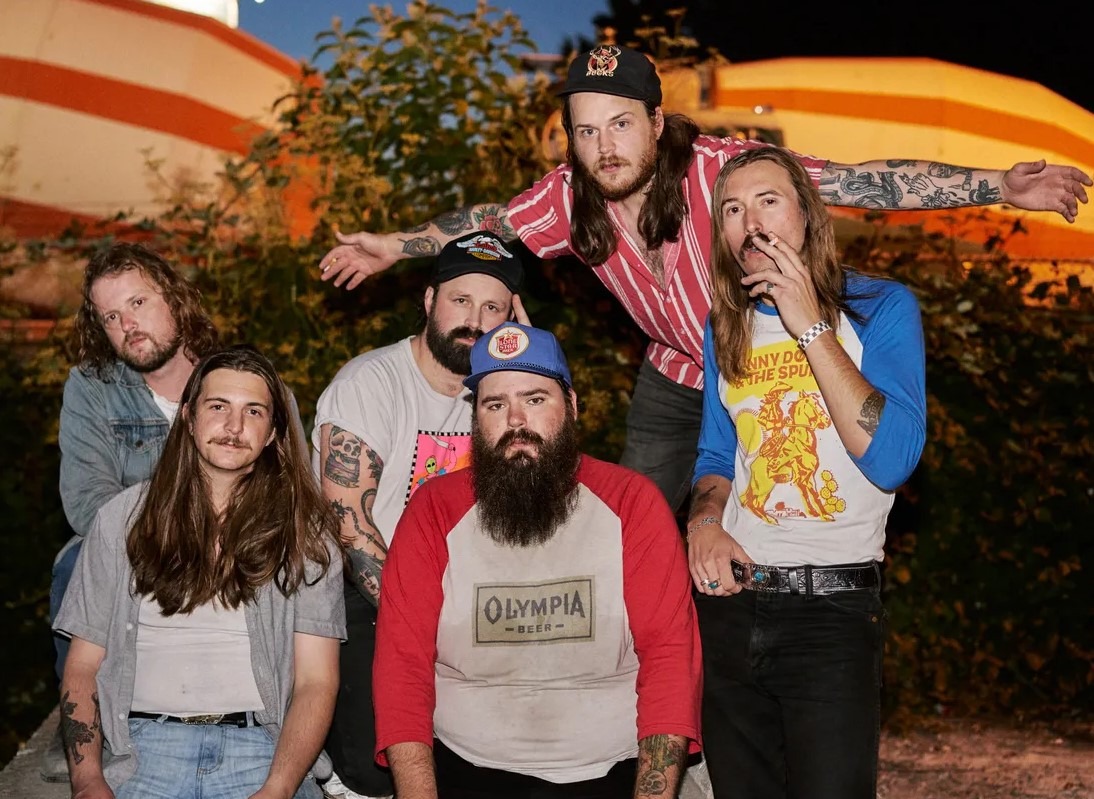
Smoker Dad is the kind of band that feels like it’s always been part of the Seattle rock ecosystem — a group whose sound is so rooted in classic rock, country swagger, and road‑tested camaraderie that it’s hard to imagine a time when they weren’t ripping through clubs from Ballard to Belltown. But their story, like their music, is a slow burn that eventually erupts into full‑blown boogie‑rock catharsis.
The band — Trevor Conway (vocals, guitar), Teagen Conway (guitar, vocals), Chris King (vocals, keys, harmonica, tambourine), Derek Luther (bass), Grady Caplan (pedal steel) and Adam Knowles (drums) — didn’t start out as the tight, harmony‑driven, pedal‑steel‑kissed rock outfit they are today. In fact, their earliest incarnation was, in Trevor’s words, “a lot messier, for sure… way more guitar‑focused… a lot more simple… more of a stoner rock, kind of heavier vibe” .
But evolution is the name of the game in Smoker Dad’s world. And like any good band of brothers — literal and metaphorical — they found their sound by following the road, trusting their instincts, and letting the right people into the van.
Brothers, Zeppelin, and the Accidental Beginning
Smoker Dad’s origin story begins with the Conway brothers, Trevor and Teagen, who grew up in a household where Led Zeppelin blasted through the walls often enough to leave a permanent imprint. “Our dad was always super into Led Zeppelin when we were growing up,” Trevor says. “I think me and Teagen both got pretty obsessed with them because of that” .
But despite the shared love of Page and Plant, Teagen wasn’t initially interested in playing music. Trevor tried to rope him into his high‑school bands — “I was always trying to get him to play the bass, but he did not want anything to do with it” — but it didn’t take. It wasn’t until years later, after Trevor’s previous band fizzled out, that Teagen suddenly picked up a guitar and started shredding.
That was the spark.
The brothers formed the first version of Smoker Dad with a rotating cast of players. The early lineup was chaotic, loud, and overflowing with guitars — “four guitar players total,” Trevor laughs — but it was enough to get them into the Seattle scene and onto stages like the High Dive, where they’d eventually play their first show with future bandmate Chris King.
Enter Chris King: The Missing Piece
Chris King didn’t join Smoker Dad so much as he drifted into it like a character from a rock‑and‑roll fable. “I just appeared one day and started dancing around,” he jokes. He was a familiar face at Substation, where musicians congregated to rehearse, hang out, and drink. He was also the band’s favorite bartender at Add‑A‑Ball, the Fremont pinball bar that doubles as a musician’s clubhouse.
When Chris joined the band right before the pandemic, everything changed. The lineup shifted, the songwriting matured, and suddenly Smoker Dad had a new identity. “We didn’t really find our sound until he joined the band,” Trevor says. “We split vocal duties… it’s pretty much 50‑50” .
Chris brought more than harmonies and keys — he brought direction. The band began focusing on vocal melodies, space, and groove instead of sheer volume. The jams became intentional. The riffs became tighter. The songs became songs.
And then came the pedal steel.
The Secret Weapon: Pedal Steel in a City That Forgot About It
Seattle isn’t known for pedal steel. It’s a city of fuzz pedals, not steel guitars. But Smoker Dad embraced the instrument early, thanks to a chance meeting during the pandemic.
Trevor met pedal‑steel player Chris Consolupes at a barbecue, and even though Consolupes was still learning the instrument, he fit right in. By the time the band recorded their album Hot Dog Highway, he had developed a distinctive style that helped define the band’s sound. “You can really hear him find his playing style,” Trevor says. “If you compare our first album to Hot Dog Highway, he gets a lot more… better, I guess” .
When Consolupes moved to Portland, the band found another steel player — Grady Caplin, from Windsor, Ontario — who elevated the sound even further. Grady didn’t just add atmosphere; he matched Teagen’s guitar lines and Chris King’s harmonica runs, creating a twin‑lead attack reminiscent of the Allman Brothers. “It sounds like an Allman Brothers slide or something,” Chris says. “More distortion. More rock and roll” .
The result is a band that blends Southern rock swagger with Seattle grit — a combination that shouldn’t work, but absolutely does.
Hot Dog Highway: The Song, the Album, the Metaphor
Smoker Dad’s breakout album, Hot Dog Highway, is a six‑piece rock‑and‑roll statement that mixes blues, boogie, and country‑fried rock into something uniquely their own. But the title track — a sprawling, jam‑heavy, piano‑driven epic — almost didn’t exist.
“It was the last song on the record that we finished,” Chris says. “We finished it pretty much in the studio. I went home and wrote the lyrics… we played it live in the studio with the piano” .
The band recorded the track live, all in the same room, capturing the raw energy that defines their sound. The song shifts gears multiple times, moving from slow burn to full‑tilt boogie, mirroring the unpredictable nature of life on the road.
And speaking of the road — what exactly is the Hot Dog Highway?
“It’s the road that you keep traveling down,” Chris says. “It’s like a bunch of dudes in a van. You know, that’s our bun.” Trevor adds, “The van is our bun, and we are the dog” .
It’s a metaphor that’s both ridiculous and perfect — a distillation of the band’s humor, camaraderie, and commitment to the grind.
Finding Their Groove on Stage
Smoker Dad’s live shows are high‑energy affairs, built around uptempo rockers and party songs. That’s why Hot Dog Highway — the song — doesn’t make the setlist often. “Our shows are usually very energetic,” Trevor says. “Most of the slower songs… we don’t really bring out live as much because it drops the energy” .
But when they do play it, it’s special. Chris recalls performing it at an underground party in South Lake Union, where he got to play a real grand piano in a “dirty, dungeon‑y” basement venue. “Everybody loved it there,” he says. “That one was my favorite time we played Hot Dog Highway” .
Still, the band knows how to craft a setlist that keeps the crowd moving. They lean into the rockers, the harmonica‑driven boogies, the songs that make people dance. And with new material on the way, they’re more excited than ever to bring fresh energy to the stage.
Part II, No Part I, and the Band’s Sense of Humor
Smoker Dad opens Hot Dog Highway with a track called “Part II,” which naturally raises the question: where’s Part I?
“It was just a joke,” Trevor says. “We didn’t know what to call it, so we were like, let’s call it Part II, and there is no Part I” .
The band has written several songs that could be Part I, but none have officially earned the title. Maybe the next album will start with Part III. Maybe Part I will close the record. Maybe it’ll never exist.
That’s Smoker Dad — serious about the music, not so serious about the mythology.
A Band Built on the Road Ahead
Smoker Dad is a band that thrives on momentum. They’re writing new songs. They’re pushing their sound into louder, more rock‑driven territory. They’re embracing the pedal steel as both a country instrument and a rock weapon. They’re building a catalog that blends classic influences with modern grit.
Most importantly, they’re doing it together — in the van, on the stage, and in the studio.
The Hot Dog Highway is long. It’s weird. It’s loud. And Smoker Dad is driving it full speed, windows down, harmonica wailing, pedal steel screaming, guitars locked in, and the bun holding it all together.
Discover more from Guerrilla Candy
Subscribe to get the latest posts sent to your email.