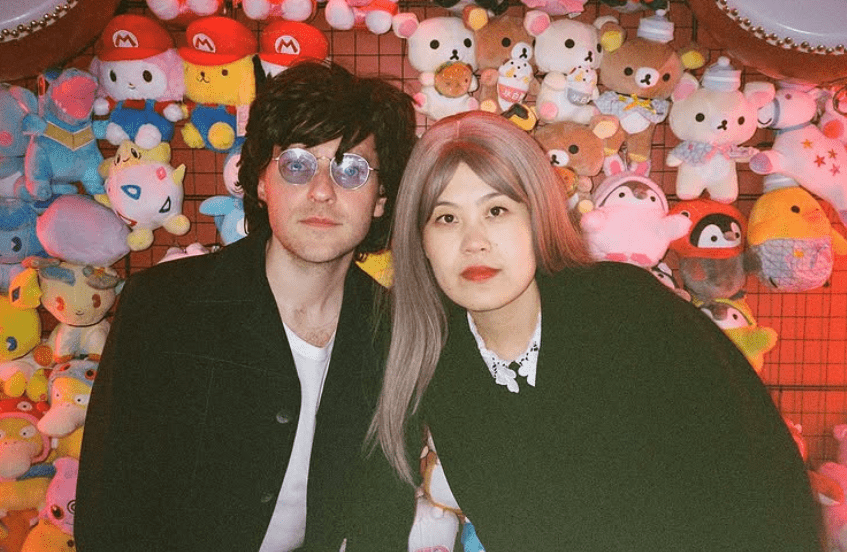
Sometimes music needs to be fun. And fun is one of the many defining attributes of the music made by Bryce Barsten and Anne Tong, the group collectively known as Chinese American Bear. The pair started the group as a way to have fun during the early days of the COVID pandemic and evolved into a DIY project that’s had minor Internet and international success.
The band isn’t just a bedroom recording project, aside from playing fun pop tunes, they’re known for interactive live shows that include dancers in dumpling hats, plushy tossing and even small lessons in Mandarin. The band’s second album, “Wah!!!,” is a record filled with playful pop gems we know you’ll love. So be prepared to get stuck songs about boba tea and dim sum your head for days while you sing and dance along to the sounds of Chinese American Bear.
I recently chatted with Anne and Bryce about their career, live shows and the cultural impact of Chinese American Bear. Below is an edited transcript of our conversation.
Tell me about how the band started and how you both met.
Bryce: Yeah, I guess we could start with how we met first, since that was a long time ago.
Anne: A long time ago.
Bryce: Do you want to start?
Anne: Yeah, sure. So we actually met 17 years ago, and we both grew up in Spokane, Washington.
So we met in high school in Spokane, started dating then, and then got married 10 years into dating. So we’ve been married for seven years, and we started this band during COVID. So for a combination of reasons, we used to live in New York for about a decade, and then around COVID, we left New York.
Bryce has always been in bands, writing and producing, since he was like 12. I grew up playing classical piano, didn’t really have band experience. But during COVID, Bryce was looking for a new music project.
He had just left a pretty serious band in New York and was in search for his next thing to dive into. And around the same time, I was also teaching Bryce how to speak Mandarin Chinese, because he wanted to be able to communicate with my family better. We want to raise our future kids bilingual.
So he started learning Chinese, and then he just thought the tones and sounds of Mandarin are really cool and might be really cool to write music with, just for something different. And so I started writing lyrics for the songs that he was composing and producing.
And then that turned into him wanting to record me singing those lyrics, because I can pronounce the words better. And then it kind of snowballed from there. He started recording my voice. I have no singing background. But it was really fun.
Bryce: I’ve always been a fan of singers that aren’t singers. A lot of the music that I just gravitate towards, I think, are those kinds of singers. I think I was also very inspired by Anne not being really a singer.
There’s definitely a quality to someone’s voice if they don’t have training. So that was also really exciting to me. To produce her voice and try and get it to fit to music.
Anne: Then we just started putting songs on YouTube, started an Instagram channel, and it just kind of snowballed from there.
Bryce: It was really accidental.
Anne: Yeah, it was really for fun during COVID.
Bryce: It was definitely the most accidental band, because I’ve been in so many bands. And you’re usually kind of planning this thing. It’s like, let’s start a band, man. Let’s do this. We’re going to do this genre. And this was so the opposite of that.
Anne: Our first music videos were in our own living room during quarantine. In our own living room, we bought a green screen off Amazon and shot it in our living room. Bryce studied computer animation in school, so he would animate the backgrounds of these very DIY music videos. And those were really fun to make, too. That’s how it started.
Bryce: I think it was our second song. We put out this song called Hao Ma. And we put out this video.
Because it was our first song that we put out, like most songs you put out as a band, no one listens. You kind of put it into the ether and your friends listen and that’s it. And it was our second song, I think, that we put out this music video. And it kind of caught on on Reddit somehow.
Anne: It wasn’t like insane viral. It was like a few thousand people watched it. But we were excited for the few thousand people.
Bryce: I mean, any band can hope for this. Even like a small little burst of virality. Especially when you’re not trying. You’re not expecting it.
But I think that definitely made us stop and take a step back. Like, oh, people like this. Maybe there’s something to this.
Anne: And we kept writing music after that.
How do you decide which lyrics are in Mandarin and which are in English? Is it something that comes naturally or is it just like, you know what, this would really pop in Mandarin and this sounds kind of boring in English or vice versa?
Anne: Yeah. So I would say for our first album, it was a little bit more random, spur-of-the-moment decisions.
We were still trying to find our sound, our voice, so whatever we felt like during a recording or writing session, we kind of just went with the first gut lyrics that came to mind. They really were not overthought or overwrought. You know what I mean?
In our first album, it was like…
Bryce: We didn’t have any kind of structure. Not that we had much on the second album either, but…
Anne: But it was more like, so what topic do we want to talk about with this song? And then we would find the topic and it’s usually something that we like to eat or do. And then just came up with some Mandarin words that sounded both pleasant to the ear and also would be fun to say, like the mouthfeel of the word would be fun to say, especially for non-Chinese speakers.
And also the reason why our topics are all kind of silly or more surface level is because my Mandarin is limited to an elementary school student. So I don’t have the Chinese vocabulary to talk about anything that’s like life philosophy or et cetera.
So we keep the topics really light and on the more silly side. Because that’s just the limit of my vocabulary. But I would say on our second album, Wah!!!, we were slightly more intentional with making the verses in Chinese and the English, the chorus in English.
Bryce: We’re making it sound almost more structured than it is. But yeah, we kind of like, oh, maybe this works best, you know?
Anne: Yeah. In case people want to sing along to the chorus. I feel like people like to sing along to choruses more. So we tried to a little bit more intentionally make the choruses English and the verses in Chinese.
Let me ask about the live experience. Tell me about the importance of engaging with your fans while you’re performing and what people can expect from a live experience from Chinese American Bear.

Anne: So when we first started playing live, I remember just being extremely nervous. Bryce had a lot more experience performing in bands than me.
So I was just really, really nervous. And so I really intentionally thought about how I wanted to perform live. And I remember thinking, while I’ve been in a lot of shows as an audience member, feeling kind of bored of the set.
Just kind of like, oh, I’m not feeling the music as much. Kind of just waiting for the set to be over. And I just never, ever wanted my audience to feel that way when they watch us.
I want people to always walk away from our shows feeling like they had a lot of fun, that their time was worth it to be there, to watch us. So Bryce and I started brainstorming just different ways to make the shows really engaging.
Bryce: Yeah, just as silly as possible. When we make the music, we get into really silly moods. And so I was like, well, let’s just bring that to our live shows and do stuff that’s off the cuff and a little embarrassing. And, you know, just make it a fun night for people.
Anne: I wanted to think about how I want to be entertained. And that’s what we did. So that’s where the dancing animals or dumplings came from. We also have a dancing grizzly bear head.
And some of our songs, like the dumpling song, is kind of chanty. Some of it is chanting stuff out loud. So we were like, well, let’s come up with a silly dance during the chants and then teach it to the audience.
And I always think it’s fun to, whenever you have a big crowd at a sports game or something, it’s fun to throw things into the crowd. So I was like, we got to throw stuff into the crowd. And so that’s where we got the idea of throwing plushies.
So we throw plushie key chains at every show into the crowd. Kids love it. People love it.
It’s just really fun. Who doesn’t love a free plushie?
It’s just what are low cost, at least for us, DIY low cost ways of making it fun. And also, I know that not all of our audiences speak Chinese. So the other way I like to engage the audience too is before every song, I try to explain what the next song means or some of the cultural background of the song.
And people find that fun too. I’ll teach a little Chinese in between songs and explain some of the cultural context.
Let’s talk about the other half of the audience because you guys toured China, which I find to be fascinating because I’ve never talked to a band that’s gone to China, which is really cool. How did the Chinese tour happen? How were you received in China as opposed to how you’re received over here?
Bryce: I’ll answer first part.
Anne: Okay, sounds good.
Bryce: We were invited by this band called City Flanker and they’re a band based out of Hangzhou, just like near Shanghai. And they just messaged us on Instagram one day. We didn’t know who they were.
And they were like, you should come tour in China with us because they’re about to release an album around the same month that we were releasing Wah!!!. And we were like, oh, ha ha, that’d be so cool. Like it’s a joke.
And then they’re like, no, really, you should talk to our manager. And so we got into contact and it was like a week later, we were like, all right, let’s do this. And yeah, we just had to figure out the visa situation and whatnot.
So yeah, we were going there to do a co-headline tour with this band.
How did that work with, was there a lot of hoops to jump through?
Bryce: There were just so many hoops to jump through. Yeah, to get our visa, then you have to get approved in every city you’re playing in.
Anne: You get an artist’s license for every single city and we toured 14 cities. And so in order to get this license, we had to submit all of our lyrics, all of our video recordings, all of our audio recordings, because the government has to comb through the lyrics and make sure there’s nothing that they’re against. And then lucky for us, we sing about boba tea and dumplings. So our lyrics are pretty curated.
Bryce: No hidden agendas. Yeah.
Anne: Although we did run into a little trouble with like our name even. I think our name was the only thing that gave us some trouble on Chinese socials.
Bryce: Because it has American in it, which seems so innocent to us.
Anne: But it’s a trigger word on their social media accounts to have American in the word.
Bryce: I think, I think you’d find this interesting that the concept of Chinese American, like a Chinese American doesn’t really exist in China.
Anne: Because why would it?
Bryce: But like, even the words that we, like the characters that we have in our name in Chinese is like, it almost feels like gibberish to them, which is, I find so fascinating because it’s like to us, it’s like a mixed, you know, person, like a Indian American or Chinese American. It’s so common. But there that doesn’t really exist.
Anne: Yeah. And they’re not exposed to like the culture, like the Asian American culture. There’s just no such thing, because everyone’s Chinese.
So yeah, that, that concept is very foreign and they just don’t understand it. So our name really confused people.

So how was your music perceived or received?
Anne: Very different. So we learned a couple of things. So first, the majority of Chinese people still listen to mainstream pop music.
There’s not as big of an indie following as in the West. And also mainstream Chinese pop culture is very emotional, overly indulgent ballads.
Like that’s their pop music. That’s what they’re used to, like very over the top, dramatic, emotional ballads. So that’s what the majority of population listens to first of all.
And then if you are an indie listener, they call it underground music. The underground music that people like are like very hard rock, metal, punk ….
The exact opposite of what you guys do.
Anne: Exactly. So like, we’re kind of like happy indie pop. And like, there’s just no such thing as indie pop there.
So everything is either melancholic, like meant to be very emotional or very aggressive. So there’s not something that’s just like super light hearted, like our music. So when we started playing, first of all, like some of our lyrics reference my own Chinese American cultural experience. And so that doesn’t really resonate in China. That only resonates when we play shows in the West. So the Chinese American nature of it, that doesn’t resonate.
So we had a couple of different reactions. So one reaction would be like, this is really weird. Like I’ve never heard music like this.
This positive, happy music they’ve never really heard before.
So people either thought it was weird or people loved it. Like if we got two reactions, like the people who loved it were like, whoa, this is so refreshing. Like I’ve never felt happy at a concert before, which is wild to us because we go to concerts to enjoy and be happy.
Or people just thought we were really weird and didn’t really know how to react.
Bryce: Yeah. Maybe it was just too far too far.
Anne: Chinese music listeners are lyric first listeners. Top 40 music all has very poetic, deep lyrics. The Chinese language is like 5,000 years old. So everything’s extremely poetic. So they really value well-written lyrics and like, you know, our lyrics, it’s like, let’s fold a dumpling. So when they would hear our lyrics, I think they would get really confused.
Discover more from Guerrilla Candy
Subscribe to get the latest posts sent to your email.